
The Lean Angle: From Force Balance to Game Code
The force balance that sets a motorcycle’s lean in a steady corner, the grip ceiling it runs into, and why real bikes lean further than the textbook formula.
I. Motivation
Every rider learns early that a motorcycle turns by leaning, and most learn it as a feeling rather than as a fact. Yet the lean is not a matter of style or of nerve. For a given speed and a given corner there is one lean angle at which the bike neither falls into the bend nor stands back up, and the road dictates it as firmly as gravity dictates that a dropped key falls.
This article opens the Physics section with that angle. It derives the lean from the forces at the tyre, reads what the formula says and what it leaves out, finds the ceiling that grip places on it, and explains why measured leans come out larger than the textbook value. It closes with the same result seen from the other side of the screen, as a few lines of game code.
II. The Force Balance
Take a motorcycle travelling at a steady speed $v$ around a bend of constant radius $r$ on a flat road, and look at it from behind. Bike and rider form a single mass $m$ with a combined centre of gravity G. Only two things act on them from outside: gravity, which pulls on G with a force $mg$, and the road, which pushes on the tyres where they touch it.
The road’s push has two parts. Its vertical part, the normal force $N$, holds the machine up, and since nothing accelerates vertically it must equal the weight. Its horizontal part, the grip force $F$, is the only force that can bend the bike’s path into a circle, so it must supply exactly the centripetal force that a circle of radius $r$ at speed $v$ demands:
$$N = mg, \qquad F = \frac{m v^2}{r}.$$Keeping the mass on its circle is not yet enough, because the bike must also hold its lean. The road’s total force, the sum of $N$ and $F$, must therefore pass straight through G. If it passed to one side, it would twist the bike about its centre of gravity, and the lean would grow or shrink until the force line ran through G again. In a steady corner, then, the line from the contact patch to the centre of gravity leans at exactly the angle of the road’s force, and that angle $\theta$ satisfies
$$\tan\theta = \frac{F}{N} = \frac{m v^2 / r}{m g} = \frac{v^2}{g\,r}.$$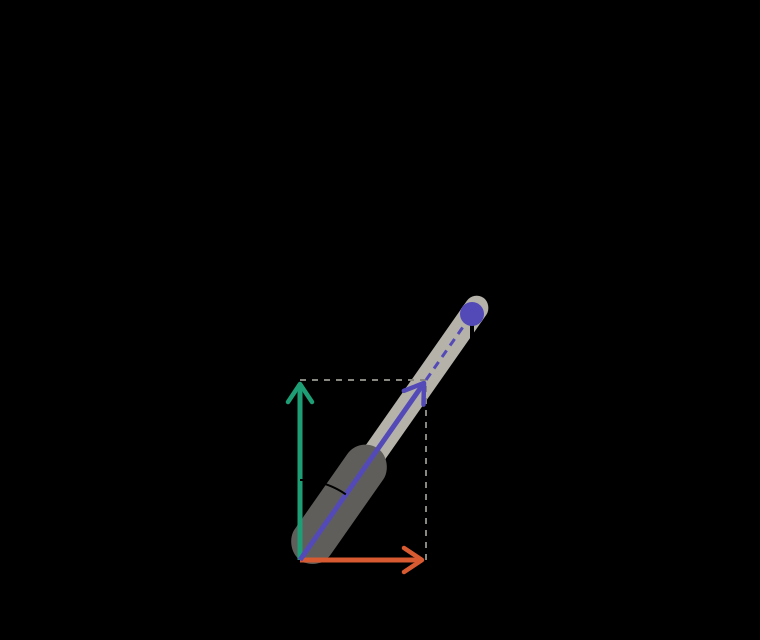
The right-hand side is the lateral acceleration $v^2/r$ expressed as a fraction of $g$, and the lean angle is simply its arctangent.
III. What the Formula Says
The first thing the formula says is what it leaves out. The mass has cancelled, so a light trail bike and a heavy tourer, treated as point masses, must lean to the same angle to take the same corner at the same speed. Neither the engine nor the rider’s weight appears; only the speed and the radius do.
The second is that the demand grows with the square of the speed. A 50 m bend taken at 30 km/h asks for 0.14 g and about 8° of lean. At 60 km/h, twice the speed, the demand quadruples:
$$v = \frac{60}{3.6} = 16.67\ \text{m/s}, \qquad \frac{v^2}{g\,r} = \frac{16.67^2}{9.81 \times 50} \approx 0.566, \qquad \theta = \arctan 0.566 \approx 29.5^\circ.$$The third is a landmark worth remembering: 45° of lean corresponds to exactly 1 g, since $\tan 45^\circ = 1$. The table shows how quickly the angle climbs towards it.
| Lateral acceleration | Lean angle |
|---|---|
| 0.25 g | 14.0° |
| 0.5 g | 26.6° |
| 0.7 g | 35.0° |
| 1.0 g | 45.0° |
| 1.2 g | 50.2° |
IV. The Grip Ceiling
The road cannot push sideways without limit. A tyre can supply a grip force of at most $\mu N$, where $\mu$ is the coefficient of friction between rubber and surface, so a steady corner holds only while $F \le \mu N$. Dividing by $N$ turns this into a limit on the lean itself:
$$\tan\theta \le \mu \quad\Longrightarrow\quad \theta_{\max} = \arctan\mu.$$On dry asphalt, Lambourn and Wesley measured peak friction coefficients of around 1.2 for motorcycle tyres, falling to 0.7–0.9 once a wheel locks, which puts the ceiling near 50°. Wet and loose surfaces lower it sharply. The other rows below come from Wong’s standard table of road friction, as reproduced by HPWizard, and each sets its own ceiling.
| Surface | Peak μ | Grip-limited lean |
|---|---|---|
| Dry asphalt, motorcycle tyres | ≈ 1.2 | ≈ 50° |
| Wet asphalt | 0.5–0.7 | 27–35° |
| Gravel | 0.6 | 31° |
| Dry earth road | 0.68 | 34° |
| Wet earth road | 0.55 | 29° |
The gravel row deserves a word. Its ceiling is set less by the tyre than by the surface itself, since, in the source’s phrase, “the gravel is constantly sliding on itself”.
Grip is not the only ceiling. A motorcycle can lean only until its footpegs, stand or exhaust reach the road. Carter, Rose and Pentecost, citing Bartlett, put the maximum lean of most motorcycles between 25° and 50°, and conclude that for many machines this geometric limit is more restrictive than the friction limit. On a wet road the order changes: for any bike that can lean past 35°, grip runs out before the hard parts touch down.
V. Why Real Motorcycles Lean Further
The formula treats the tyre as a knife edge. A real motorcycle tyre has a rounded cross-section, and that changes the geometry in a way that always asks for more lean.
When the bike leans, the contact point P rolls round the tyre’s profile to the inside of the wheel’s plane. It always sits directly beneath the centre C of the tyre’s circular cross-section, at a distance $t$ equal to the crown radius, roughly half the tyre’s width. The centre of gravity G still lies in the wheel’s plane, at a distance $h - t$ from C, where $h$ is its height above the road with the bike upright. The force balance of Section II has not changed: the road’s force must still run from the contact point to G, at the angle $\varphi_0 = \arctan\left(v^2/g r\right)$. The contact point, however, has moved, so the wheel itself must lean further, to an angle $\varphi$.
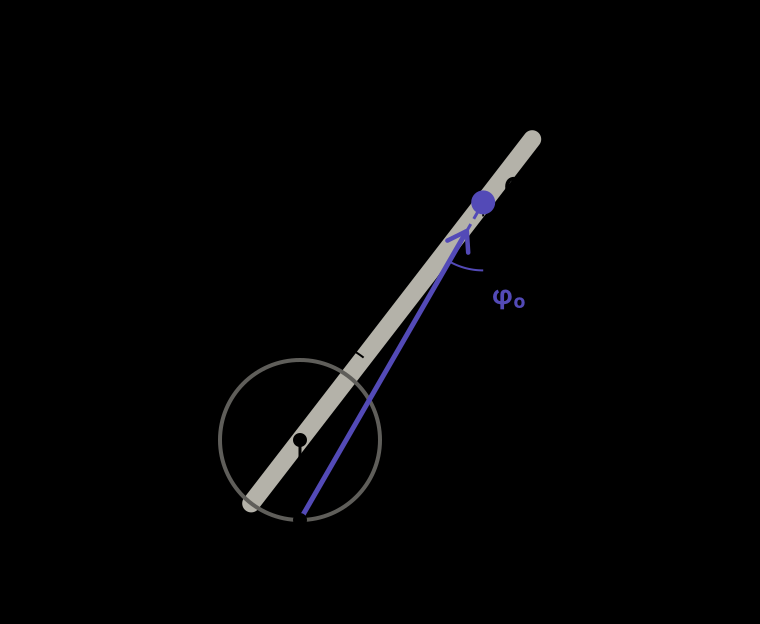
The triangle P, C, G gives the answer. Its angle at P is $\varphi_0$ and its angle at C is $180^\circ - \varphi$, so its angle at G is $\varphi - \varphi_0$, and the law of sines ties these angles to the two sides we know:
$$\frac{t}{\sin(\varphi - \varphi_0)} = \frac{h - t}{\sin\varphi_0} \quad\Longrightarrow\quad \varphi = \varphi_0 + \arcsin\!\left(\frac{t\,\sin\varphi_0}{h - t}\right).$$This is the correction that Carter, Rose and Pentecost use, after Cossalter’s Motorcycle Dynamics. To see its size, take the 60 km/h corner again with a 140 mm rear tyre, the size fitted to the Royal Enfield Himalayan 450, whose crown radius is about 70 mm, and a combined centre of gravity 680 mm above the road. That last figure is illustrative, since manufacturers rarely publish one. The ideal lean of 29.5° becomes
$$\varphi = 29.5^\circ + \arcsin\!\left(\frac{70 \times \sin 29.5^\circ}{680 - 70}\right) = 29.5^\circ + 3.2^\circ \approx 32.7^\circ.$$Three degrees matter. A rider who trusted the textbook figure would sit closer to the grip ceiling than they thought, and the wider the tyre, the larger the gap.
Carter, Rose and Pentecost tested these formulas with two instrumented motorcycles, ridden by novice and expert riders along painted curves, and found that the basic formula consistently underestimates the lean. Adding the tyre-width correction reduced the average error, but it did not bring the prediction up to the average of their measurements. The basic formula also assumes that rider and machine lean together, which riders seldom do; how the rider’s position changes the bike’s own lean is the subject of a later article.
VI. The Same Formula in a Game
A game rarely knows the radius of the corner a player is taking, but it always knows two equivalent quantities: the bike’s speed $v$ and its yaw rate $\omega$, the rate at which its heading turns. On a circle $v = \omega r$, so the lateral acceleration $v^2/r$ is simply $v\,\omega$, and the lean follows without any radius at all:
$$\tan\theta = \frac{v\,\omega}{g}.$$At 20 m/s, with the heading turning at 0.3 rad/s, the lateral acceleration is 6 m/s², or 0.61 g, and the bike should lean about 31.5°. Capping the result at $\arctan\mu$ for the current surface gives the game a principled moment at which to let the tyres slide.
import math

G = 9.81  # m/s²


def target_lean(speed: float, yaw_rate: float, mu: float) -> tuple[float, bool]:
    """Lean in degrees for the current turn, capped at the grip limit, and whether the tyres slide.

    speed in m/s, yaw_rate in rad/s (positive turning right); the sign of the lean follows the turn.
    """
    lateral_g = speed * yaw_rate / G
    sliding = abs(lateral_g) > mu
    lean = math.degrees(math.atan(min(abs(lateral_g), mu)))
    return math.copysign(lean, lateral_g), sliding
In practice a game would ease the bike’s visible lean towards this target over a few frames rather than snap to it, because a real motorcycle takes time to roll into a corner. That transient, and the countersteering that starts it, belong to the dynamics this steady-state picture leaves out.
VII. Outlook
The steady-state formula is a reference rather than a forecast. It fixes the lean of the line from the tyre to the centre of gravity, and tyre width, the rider’s position and the dynamics of getting there then decide how far the motorcycle itself leans. The next article follows the grip budget further, into the friction circle, where braking and cornering draw on the same limited supply.
References
- Carter, N., Rose, N. A. and Pentecost, D. Validation of Equations for Motorcycle and Rider Lean on a Curve. SAE International Journal of Transportation Safety 3(2), 2015. doi:10.4271/2015-01-1422.
- Lambourn, R. F. and Wesley, A. Motorcycle Tire/Road Friction. SAE Technical Paper 2010-01-0054, 2010.
- Wong, J. Y. Theory of Ground Vehicles, 1993, p. 26, as tabulated in HPWizard, Tire Friction Coefficient, hpwizard.com.
- Cossalter, V. Motorcycle Dynamics, 2nd edition, 2006: the source of the tyre-width correction, as cited by Carter, Rose and Pentecost.
- Royal Enfield, Himalayan 450 Technical Specifications: rear tyre size 140/80 R17.